A Tribute to Leong Po-lam (Apo Leong) – Key Architect of the Asian Victims’ Movement
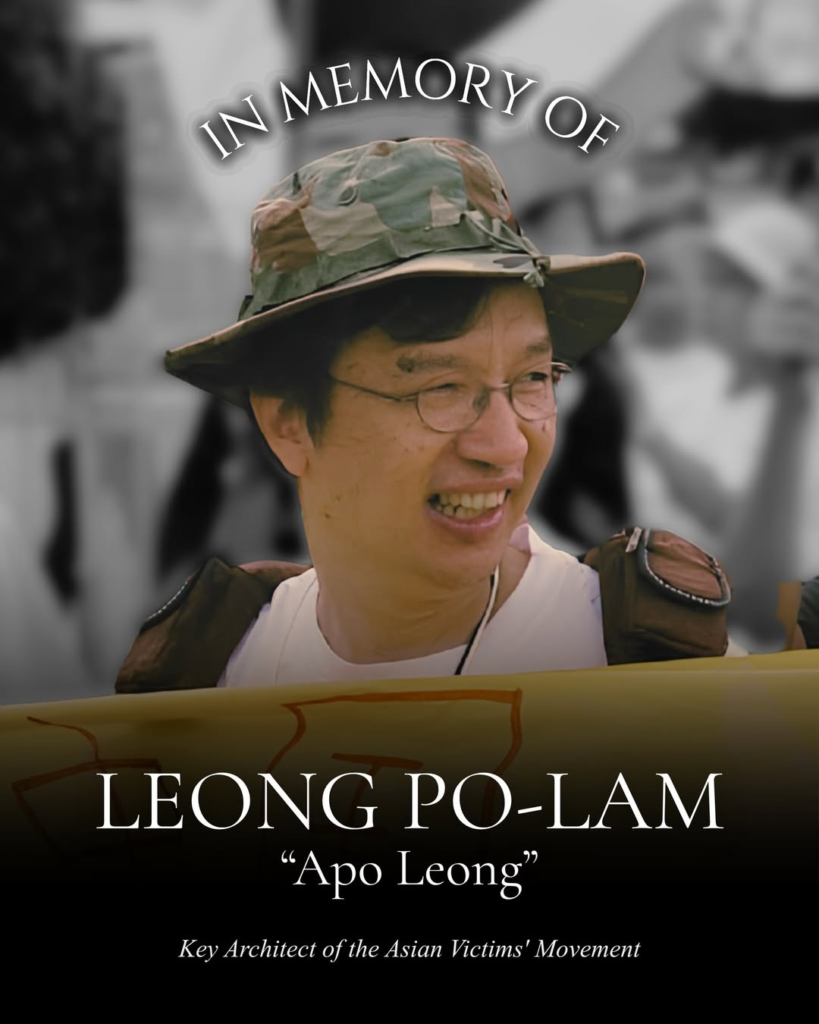
As we continue to absorb and process the heavy news of Apo’s passing, it is difficult to imagine the victims’ movement without Apo. With deep humility and respect, we honour the foundational role he played in building and strengthening our network – a core pillar of not just the Asian grassroots labor movement but the global struggle for workers’ health and safety.
A tireless organizer and staunch defender of workers’ rights, Apo’s leadership at the Asia Monitor Resource Center (AMRC), a regional labor organization based in Hong Kong, came at a critical juncture. Asia was transforming into a manufacturing hub for global supply chains in a brutal race to the bottom, defined by young workers toiling in hazardous sweatshops.
In 1993, he witnessed the real cost of ‘cheap labor’ when more than 250 young workers, mostly women, lost their lives, and countless others were severely injured. Many were forced to jump to their deaths because the factory doors had been locked. It was the worst industrial disaster of its time and sent shock waves across the world.
Apo stood at the forefront of the fight for justice for the victims of these fires. Relentlessly working with organizers on the ground, he was instrumental in building solidarity within the Asian labor movement and across the globe to hold employers and multinational brands accountable. He upheld a unified demand: workers would no longer be used as cannon fodder for global supply chains; they required safe workplaces, labor rights, and fundamental dignity. This tireless struggle led to the amalgamation of existing victims’ movements across many parts of Asia, including South Korea, Japan, Taiwan, and Hong Kong, culminating in the creation of the Asian Network for the Rights of Occupational and Environmental Victims (ANROEV) in 1997.
Apo’s vision and leadership were instrumental in building this genuinely indigenous Asian network. He believed deeply in the inherent agency of the victims themselves. Under his guidance, victim-led organizing became—and remains—ANROEV’s central strategy in its ongoing pursuit of justice.
He witnessed numerous victories, securing justice for silicosis victims in India and China, as well as for electronics workers across Korea, Taiwan, and the Philippines. Over time, the ANROEV grew into the world’s largest grassroots network of its kind—one led by the victims themselves, uniting workers with the broader environmental movement. Rana Plaza tragedy in Bangladesh humbled him; the scale was much bigger than both Kader and Zhili, and the supply chain murders in Asia continued.
“The fight will continue until all workplaces are safe and healthy,” he vowed. A monumental milestone was finally reached in June 2022 when the International Labour Organization (ILO) elevated occupational safety and health (OSH) to a fundamental right at work, marking a major victory for both the labor movement and the network.
As we continue our work to ‘remember the dead and fight for the living,’ to honor fallen heroes at workplaces, we want to extend our deepest gratitude to Apo for his relentless support of the victims’ movement. We also wish to express our profound thanks to Apo’s family for sharing him with us so that he could build this movement.
We will continue the struggle for safe and healthy workplaces and justice, but we will miss you dearly, Apo.
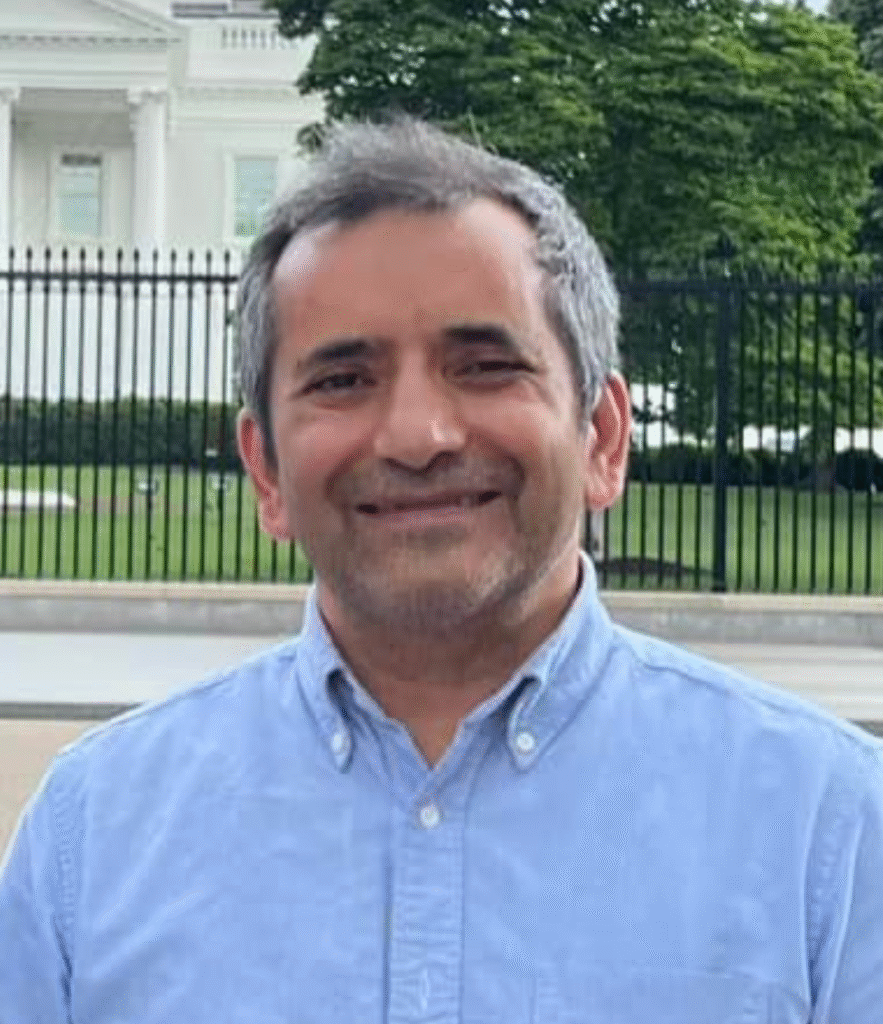
This tribute is written by Sanjiv Pandita, who worked alongside Apo for years at the Asia Monitor Resource Centre and stood with him in building ANROEV from the ground up.
Sanjiv is an occupational and environmental health expert with decades of work on workers’ rights in the electronics industry. Alongside Apo, he is a founder of the Asian Network for the Rights of Occupational and Environmental Victims (ANROEV) and has worked with grassroots groups across Asia on supply chain hazards, worker organizing, and OHS training. He is the current Asia Program Senior Advisor at the Solidarity Center.